| Roman Period | |
|---|---|
| No particular locality around the Hinckley area has been definitely identified with Roman occupation, but there is much scattered evidence that points towards the probability that Hinckley was an occupied site in Romano-British times. | |
| Middle Ages | |
| Hinckley started as a Saxon village which was known as Hinca's Leah, the meaning of Leah is a clearing in the wood. By 1086 Hinckley was a big village with a population of around 300 people. | |
| In the Middle Ages Hinckley had a fair which was a market that was held normally once a year. People came from all over Leicestershire and Warwickshire to either buy or trade at the fair. | |
| 11th Century | |
| 1043 | Leofric who was the Earl of Mercia and the husband of Lady Godiva, gave the village of Aston Flamville, Burbage and Sketchley to Coventry Abbey. |
| 1086 | Hinckley is recorded in the Domesday Book as having 69 families. Stretton Baskerville was held by Roger of Ralph de Mortemer. |
| 12th Century | |
| 1100 | A small Abbey (Priory) established. |
| 1151 | When the Normans built Hinckley Castle which overlooked the town, it eventually fell into ruins. |
| 13th Century | |
| 1240 | St.Marys Church built, St.Mary's is also home to the famous Bleeding Tombstone. |
| 14th Century | |
| 1311 | This was the date of the first recorded market in Hinckley, although markets may have existed earlier. |
| 15th Century | |
| 1485 | The Battle of Bosworth Field, the last great battle of the War of the Roses took place about five miles north of Hinckley. The Yorkist King Richard III was killed, to be succeeded by Henry VII. |
| 16th Century | |
| 1551 | A charter was granted by Edward VI allowing a weekly market to be held, on Mondays, in Hinckley. |
| 17th Century | |
| Early 17th Century Hinckley's population grew to around 1,000 people. | |
| 1600 | William Shakespeare wrote the play 'Henry IV Part 2' that mentions Hinckley. |
| 1613 | John Cleveland was born, he would become one of the most popular English poets of the 17th Century. |
| 1626 | There was an outbreak of the plague in Hinckley and also 1666. |
| 1629 | Hinckley Grammar School was first mentioned in parish records. It became John Cleveland College in 1974. |
| 1640 | The first stocking frame came to Hinckley (installed in the town by William Iliffe) and changed the town forever; Hinckley's main industry was now making stockings. |
| 1644 | In March 1644 Hinckley was occupied by the Royalist troops, but a Parliamentarian army drove the Royalist army out of the town. Hinckley did not suffer too much during the English Civil War (1642-1651). |
| 1666 | Like other towns in the country, Hinckley would also suffer from the Plague, causing 143 deaths. |
| 1671 | A Coaching Inn with a stable yard entrance called The George Inn was built in the Market Place, it would later become known has The George Hotel. |
| 18th Century | |
| Early 18th Century the population had now grown to around 2,000 people, due to the hosiery industry | |
| 1705 | Lindley Hall was rebuilt by Samuel Bracebridge, on a site to the north of the original moated building situated on a hilltop near Higham on the Hill. |
| 1717 | William Bass was born in Castle End, Hinckley. He would later establsh The Bass Brewery at Burton-upon-Trent in 1777. |
| 1720 | The Great Meeting Chapel, the oldest non-conformist Chapel in Hinckley was built. |
| 1722 | The Atkins Brothers of Hinckley hosiery factory was founded (the predecessor of Aspira). It is the oldest hosiery manufactory in the world. |
| 1727 | The gruesome murder of Richard Smith with the use of a Halberd outside 'Pig and Whistle' along Regent Street in Hinckley. It is said that the Gravestone bleeds on the anniversary of his death. |
| 1730 | Dick Turpin the notorious highwayman would ride Black Bess along Watling Street and stop at the deserted medieval village of Stretton Baskerville, he was also known to hide at The Cock Inn at Sibson. |
| 1750 | Gopsall Hall was built on a park of 300 acres for Charles Jennens a collector of fine art. Gopsall Hall was once the grandest Georgian country house in Leicestershire. Robert Chessher was born and would later become the famous Dr Robert Chessher who was the first British Orthopedist and inventor of double-inclined plane for treatment of lower-body bone fractures. |
| 1760 | The site of Hinckley Castle was purchased by William Hurst, Esq., who built a mansion upon it called Castle Hill House. William Hurst was a hosier and High Sheriff of Leicestershire. |
| 1771 | John Wesley (The Methodist preacher) was known to visit Hinckley in the year of 1771, he called the town 'one of the civilest towns I have ever seen'. |
| 1788 | The spire of the parish church of St.Mary the Virgin was erected. |
| 1793 | During the winter, a subsription was raised at Hinckley, when 2,400 pairs of good, strong, servicable Worsted Stockings, and 70 Flannel Waistcoats were contributed and sent to the British Troops, then serving on the continent, under the command of his Royal Highness the Duke of York. |
| 1798 | The Manor House was built at the Junction of Upper Bond Steet and Hollycroft Hill. |
| 19th Century | |
| During the early 19th Century Hinckley's population only grew to 6,177. Hinckley suffered with a lot of hardship and poverty even though the main industry was still dominated by hand weavers. By the time the later part of the 19th Century came along, the hand weavers were replaced by steam powered frames in factories which saw Hinckley start to boom. This led the population to grow to around 11,000 by 1900. | |
| 1802 | On 01-Apr-1802 fourteen sheep were roasted in the Town streets for the rejoicing on the conclusion of Peace with France. |
| 1803 | The inhabitants subscribed £678 15s. 6d. for the support of the Hinckley Volunteer Infantry. |
| 1804 | The Ashby Canal (the longest contour canal in England) opens and passes through the town. |
| 1807 | George Canning (1827 British Prime Minister) moved in to the Castle Hill House in Castle Street, so that his son ‘George Charles’ could be under Dr Chessher’s care. |
| 1830 | A Fire Station was built along Stockwell Head. |
| 1834 | A site was purchased on Coventry Road from Mr John Blakesley to build The Gas Works which would be known as the Hinckley Gas Light and Coke Company, this saw the introduction of the Gas lights in Hinckley. |
| 1835 | While Joseph Hansom an Architect (1803-1882) was living in Hinckley, he designed the world famous Hansom Cab. In 1835 the first Hansom Cab was made, these became very popular across Britain. |
| 1837 | The Holy Trinity Church was built that later became The Holy Trinity Parish Hall in 1910 until the bulidng was finally demolished in 1973. |
| 1838 | The Hinckley Union Workhouse was built, in London Road, to accommodate up to 450 inmates. |
| 1840 | James Harrold wrote a poem about a pub crawl called 'A Tour in Verse of Hinckley’s Pubs'. |
| 1843 | The first Police Station along Stockwell Head was built by William Parsons of Leicester, overseen by Frederick Goodyer (The First Head Constable of Leicester Borough Police). Nat Langham the bare-knuckle boxer became the Middleweight Champion of England after a fight in Hinckley with William Ellis (of Sapcote). |
| - | The William Butler was born in New Buildings, Hinckley. during 1843. He would later establsh The Mitchells & Butlers Brewery at Smethwick, Birmingham in 1898. |
| 1849 | The Mineral Baths along Ashby Road were built by James Holier, they were opened in May to the public for the recreation of visitors attending to drink the water and take the baths. |
| 1846 | 22nd April John Boultbee Brooks was born and lived in Stockwell Head, he would become the founder of J.B. Brooks & Co in 1866 making bicycle saddles. |
| 1853 | Thomas Payne introduced steam-power to the manufacture of hosiery in Hinckley. |
| 1854 | St.Marys School was built as a Sunday school along Station Road. |
| 1858 | A Cemetery was built along Ashby Road which still stands today. |
| 1859 | Work begun on a Railway that was to come through Hinckley from Nuneaton. |
| 1861 | Hinckley Railway Station built by South Leicestershire Railway opened to the public. The Hinckley Co-operative Society Ltd was founded by George Dare |
| 1866 | The Blue Plaque scheme was founded in London, later local councils across the country would follow suit. |
| 1868 | A Local Government Board was formed; they started to improve the town and local area. |
| 1870s | Hinckley was being dug up to have sewers installed. |
| 1871 | The Local Government Board purchased fourteen run-down houses to be demolished for the developement of Station Road. Queens Park was laid out as a traditional park area. A clay vessel containing a hoard of Roman Silver Coins was found near to Harrow Farm on Watling Street (now A5) during the construction of the Railway line from Hinckley to Stoke Golding. |
| 1873 | St.Marys Vicarage was built which was a magnificent building, standing amid five acres of ground. |
| 1874 | St.George's Hall was built by William Trivett who was the landlord of The George Inn. The Hall was built on a site adjoining the hotel at the rear |
| 1875 | The Leicestershire Banking Company premises built on the corner of Station Road and The Market Place. |
| 1878 | The Wesleyan Chapel was opened to the public, the Chapel was desgined by John Loxton to hold up to 800 Methodists. |
| 1884 | Charlotte M.Brame was laid to rest in Ashby Road Cemetery, she was a local Hinckley Author that wrote around 200 romantic novels during her lifetime of 48 years. |
| 1888 | The Free Library was built along Station Road. |
| 1889 | Hinckley Town Football Club was formed in Hinckley, playing their games at the Holywell ground, behind the Holywell pub on the London Road. |
| 1890s | A water pipe supply was installed around Hinckley. |
| 1891 | A Water Tower built off Highfields Street was designed by Thomas and Charles Hawksley of Westminster. |
| 1894 | The Local Government Board was replaced by an Urban District Council. The first purpose-built Hinckley Grammar School was built along Leicester Road, it consisted of just the headmaster's house and school all in one building. |
| 20th Century | |
| 1900 | The new Hinckley Cottage Hospital was built to commemorate Queen Victoria's Diamond Jubilee. |
| 1902 | The Post Office was built on the Junction of Station Road/Lancaster Road and later in the year The Constitutional Club was built along Station Road. |
| 1903 | The Council Offices was built along Station Road next to The Free Library. |
| 1905 | The Globe Inn on the corner of Church Walk and Station Road was demolished. |
| - | 8th August The religious leader General Bramwell Booth who was the founder of the Salvation Army visited Hinckley which drew a crowd in the Market Place. |
| 1907 | Established by JA Payne, Paynes Garages Ltd, one of the oldest family-owned Ford Motor Dealerships in the UK, the firm became Ford Dealers in 1922. |
| 1909 | Elizabeth Coxhead was born in Hinckley, she would become an author, critic and mountaineer. Her father Mr G.E.S Coxhead was the Headmaster at the Hinckley Grammar School. |
| 1910 | The official opening of the Swimming Baths took place by the Councillor Thomas Aucott who was the Chairman of the Council. |
| 1912 | Hinckley got an electric supply in the area. |
| 1913 | The opening of The Hinckley Theatre and Picture House which was later to become The Odeon Cinema. The people of Hinckley saw the first council houses being built in Granville Road, more houses were built during the 1920s and 1930s. The enlarging of the main sewer from the Borough, though Regent Street and on to Sketchley. |
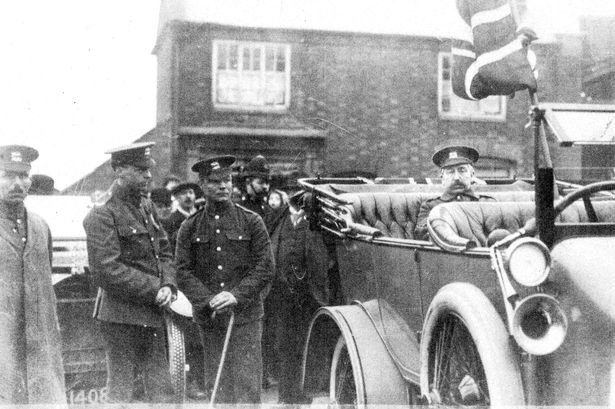
| 1914 | 28th July The outbreak of the First World War, also known as the Great War. |
| - | 24th November Sergeant William Merrick, arrived at Festubert, France to the front line with the 2nd Battalion of the Leicester Regiment. |
| - | Life in Hinckley was not going to be the same during the First World War. |
| 1915 | 14th August Hinckley’s new Billiard Hall opened in Station Road, which had 14 billiard tables. |
| - | 3rd December Sydney Dale, enlisted with the 6th Battalion of the Leicester Regiment, known as 'The Tigers' at the Leicester Town Hall. |
| 1917 | 10th June Sydney 'Togo' Bolesworth returned to the Western Front with the 9th Battalion Leicestershire Regiment in Belgium as a sniper. |
| 1918 | 11th November Armistice day - fighting ceases at 11am, the First World War comes to an end after 4 Years, 3 Months and 1 Week. Hinckley lost 385 men during the confict. |
| 1919 | The haulage company E.E Bee Ltd was founded by E.E. Bee, he started the company with just two lorries, the company would become called Bees Transport. |
| 1920 | A First World War Tank was given to the town by The National Savings Campaign and placed at Granville Gardens along Coventry Road. |
| - | 7th October Mrs Hudson bought 'Hudsons Brick, Tile and Terra Cotta Company Ltd' which was situated at The Big Pit for £375. |
| 1921 | On 27th September, The Fire Brigade turned up to a fire that gutted the Bennett Brothers Factory along Southfield Road. |
| 1922 | The War Memorial was erected in Argents Mead for those that had fallen during the conflict of World War 1. |
| 1923 | Mr W. H. Bott (owner of Bott hosiery factory) provided Hinckley with a three-year-old Swan that would be known as Jasper for the moat in Argents Mead. |
| 1927 | Louis Vierne wrote and composed 'The Bells of Hinckley' for the finale from the final fourth Suite of 'Pieces of Fantasy'. Vierne was inspired by a carillon of bells he heard from St.Marys Church. |
| 1929 | The opening of The Regent Theatre built in 1928, Rugby Road/Lancaster Road Junction. The Regent Club was built along Rugby Road. The Airship R101 was see flying over Hinckley on the return journey of an endurance trial flight. |
| 1930s | The worse of The Hinckley Slums were demolished to make way for modern council houses. |
| 1930 | A Roman Bust was found by a school boy in a heap of rubbish at Hinckley Grammar School. |
| 1931 | The Technical College along London Road was built and designed by Captain Ernest George Fowler. |
| 1932 | The Leicestershire and Warwickshire Electric Power Company is in a large impressive neo-classical style building that was designed by Arthur M.Heaton. |
| 1934 | Hollycroft Park was donated by the Atkins family as a recreational area for the people of Hinckley. |
| 1935 | The Hinckley Lido was built along Netherley Road (off Ashby Road). |
| 1936 | The Urban District Councils boundaries extended to include Burbage, Stoke Golding, Earl Shilton and Barwell. |
| 1937 | April James Pickering joined the Royal Air Force Volunteer Reserve, he would do his training at RAF Desford in Leicestershire flying the de Havilland Tiger Moth. |
| - | 17th April A new Police Station was fomally opened, it was built on the Junction of Upper Bond Street and Hollycroft Road. |
| - | 26th July The Danilo Cinema was opened by Sir William Edge (MP for the Bosworth Divison) and along with Judy Kelly who was a famous film star of the time. |
| - | 3rd December A Bristol Blenheim Mk I of 114 Squadron crash landed along Barwell Lane in Hinckley during a training flight from RAF Wyton. |
| 1939 | The Hinckley UDC acquired a disused branch factory of Simpkin, Son & Emery along Leicester Road and adapted it for use as a Fire Station. |
| 1940 | The German Luftwaffe dropped bombs around the Hinckley area during the Second World War for the first time during the month of June. |
| 1941 | The purchase of a Spitfire for the war effort by the Hinckley & District Hosiery Manufacturers Association, it was called the Hinckley Spitfire. The bombing of Hinckley happened when a German bomber released its bombs, killing 11 people in Merevale Avenue. |
| 1945 | More council houses were built around Hinckley, these included pre-fabs in Middlefield Lane (1946-1947). |
| 1947 | Police Woman Catherine Godfrey had been recalled to duty during a severe gale to deal with a violent female prisoner, on the way to the Police Station she collided with a fallen tree and sustained fatal injuries. |
| 1948 | Argents Mead was gifted to the HUDC (Hinckley Urban District Council) by Miss Margery Payne. |
| 1955 | Work started on the demolition of the Church Walk Cottages, the cottages had reached an advanced a stage of decay and the efforts to preserve them were ineffectual. |
| 1960 | A new Bus Station along Lancaster Road was opened by Mr C.R. Hodgson who was chairman of East Midland Traffic Commissioners and councillor W. K. Wileman who was chairman of the Hinckley Urban District Council. Cabbage Row terrace along Upper Bond Street was demolished to make was for a garage. |
| 1962 | The Edwards Centre was built along Regent Street. |
| 1963 | The Grammar School buildings along Leicester Road became the home of Mount Grace High School when the Grammar School moved to a new site in nearby Butt Lane. |
| 1968 | The New Council Offices was built on part of the Old Vicarage garden and the Tennis Courts between Mount Road and Argents Mead. |
| 1972 | The former premises of Moore Eady and Murcott Goode Ltd hosiery factories in Stockwell Head was converted to what is now the 400 seat Concordia Theatre. |
| - | Hinckley and Herford in Germany formalised the partnership by exchanging charters when the first family exchanges took place. |
| 1974 | Under the Local Government Act (1972), the Borough of Hinckley and Bosworth was created by the merger of the Hinckley Urban District and the Bosworth Rural District, minus Ibstock. Hinckley and Bosworth Borough was given a new Coat of Arms. |
| 1975 | The building of Percy Taylor Ltd (manufacturers of 'Ladies Pure Silk, Rayon and Mixture Hosery) was converted to what is now a Library along Lancaster Road. |
| 1977 | The new Leisure Centre was built along Trinity Lane. |
| - | 2nd December The old Swimming Baths in Station Road were demolished to make way for the new St Mary’s car park. |
| 1978 | The Health Centre along Hill Street was opened at a cost of £500,000. |
| 1981 | The Britannia Shopping Centre was built along Castle Street. |
| 1984 | Triumph Motorcycles Ltd was established at Hinckley, initially as Bonneville Coventry Ltd. |
| 1989 | The new Tesco Distribution Centre opened at Dodwell’s Bridge Industrial Estate. |
| - | 4th September Bill Maynard (Actor) married the Belgian singer Tonia Bern-Campbell (widow of Donald Campbell) at Hinckley Registry Office. |
| 1990 | Castle Mead Radio was launched, affectionately known as Britain's smallest hospital radio station. |
| 1992 | The sports car manufacturer Ultima Sports Ltd, based in Hinckley, was founded. |
| 1995 | 10th April The towns superloo on Station Road was opened, the modern public toilet block cost £140,000. The new toilets replaced the old public toilets on Church Walk. 16th September More than 500 people visited Hinckley Museum on Lower Bond Street when it opened its doors for the first time. |
| 1996 | Fosseway Radio was first aired across Hinckley and south-west Leicestershire,using presenters that were local with their knowledge second to none for the area they were broadcasting. |
| 1999 | A new Magistrates Court was built along Upper Bond Street. |
| Towards the end of the 20th Century Hinckley saw industrial estates being built at Harrowbrook, Dodwells Bridge, Sketchley Lane and Hinckley Fields. | |
| 21st Century | |
| The population of Hinckley during the 21st Century is 42,000. | |
| 2006 | The bandstand in Argents Mead park was installed to accommodate local and regional music performances. |
| 2013 | The site of the Sketchley factory units were demolished along Rugby Road, houses have now been built on this land. The building that Fludes occupied along Hawley Road was part demolished to make way for a new Council Office which is known as 'Hinckley Hub'. |
| 2014 | 'Save the Regent' was formed on Facebook to help save 'The Regent' (a former Art Deco style Cinema) they created a lot of local interest, but despite their efforts, the rear of 'The Regent' which was also known as 'Flutters Bingo' was pulled down to make way for a car park of just 35 cars for Iceland Supermarket as part of 'The Crescent' development. |
| - | 8th February - Hinckley Past & Present (Facebook group) was created. The Facebook group grew quickly and celebrated its 1,000th member by 2nd July 2014. |
| - | March - The Council Offices demolished in Argents Mead to make way for a new state of the art Leisure Centre. |
| - | 31st March - A website for Hinckley Past & Present was launched with a total of 5 pages. |
| 2015 | 13th January - The Big Pit Resistance Group was created to stop the Big Pit from being filled in and houses being built. The Group had their first meeting in the Ashby Tavern, Ashby Road which attracted around 100 people. |
| - | 10th November - The £66m development ‘The Crescent’ opened with the flagship store Sainsbury’s, marking its 600th UK store. Other shops to open a store within The Crescent were Cineworld, TK Maxx, Costa Coffee, Prezzo, Simply Gym, Poundland. |
| Hinckley Folklore | |
| According to tradition a gravestone is said to 'sweat blood' on the anniversary of a murder that took place during 1727. What are your thoughts on The Bleeding Tombstone of St.Mary's Churchyard. | |
| The story of The legend of the Oak & the Ash is about a tree that is an Oak and Ash tree which is in the middle of a field just to the South of Peckleton. | |
| Hinckley has a number of old buildings, The Union Inn is said to be one of the oldest. 'Ghostly Hinckley Pub - The Union Inn' tells the story of some strange things that have been happening in The Union Inn. | |
| Hinckley in the United States of America (USA) | |
| There are four Hinckleys in the United States of America (USA), Illinois, Minnesota, Ohio and Utah. | |